
Wilderness First Aid Certification
When 911 is hours away, do you know what to do?

If you hesitated, this certification is for you.
When things go sideways in the wild, we don't rise to the occasion, we fall to our level of training.
In town, help is minutes away. In the backcountry, you ARE the help—sometimes for hours, sometimes overnight, sometimes in conditions that are actively making things worse.
This certification teaches you to assess, stabilize, and make critical decisions when there's no ambulance coming. How to splint with what you have. When to evacuate and when to shelter in place. How to keep someone alive until you can get them to definitive care.
Knowledge & Training - what stands between panic and competence
PICK YOUR WEEKEND
September 19-20 Raleigh, NC $200
November 7-8
Confident Capability
Real wilderness adventurers aren't reckless—they're prepared. They know how to handle medical emergencies when the nearest hospital is a day's hike and a long drive away. They can assess injuries, manage shock, improvise splints, and make life-saving decisions under pressure.
This training doesn't just teach you to respond to emergencies. It teaches you to prevent them, recognize them early, and stay calm when everyone else is losing it.
It's the difference between being someone who dreams about big adventures and someone who actually goes on them. Because being capable gives you the confidence to deal with whatever happens.
What You'll Learn
While you're working through real-world scenarios in the field, you'll master the critical skills that could save a life—and more importantly, that give you the competence to venture confidently into wild places.
-
Patient assessment - The foundation of every backcountry emergency response
-
Trauma management - Controlling bleeding, treating wounds, stabilizing injuries
-
Musculoskeletal injuries - Splinting, improvising support, deciding on evacuation
-
Environmental emergencies - Recognizing and treating hypothermia, heat illness, lightning strikes
-
Medical emergencies - Allergic reactions, cardiac events, diabetic issues in the field
-
Evacuation protocols - When to evacuate, when to shelter in place, how to communicate for rescue
-
Improvisation skills - Crafting solutions with limited gear
-
Decision-making under pressure - Staying calm and effective when it matters most

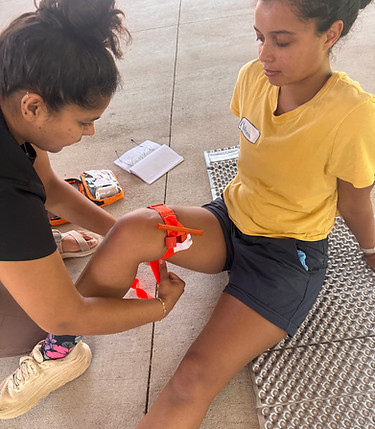
The gals from Girls Who Hike NC splinting Owen's lower leg frature.
About your Instructor

Ali has been a Wilderness First Responder since 2010. Since then, she has had extensive experience managing risks and dealing with medical issues while leading expeditions in remote areas in Southeast Asia, the Middle East and America. She previously managed the wilderness medicine training and protocols for Absolute Adventure in UAE and Oman, and for Dragonfly Outdoors in Hong Kong. She was also the medical coordinator for two different remote mountain races in the Hajar Mountains of the Musandam Peninsula- an ultra-marathon and a mountain biking race.
Practice Makes Permanent
This isn't death-by-PowerPoint. We throw realistic emergencies at you—messy, stressful, urgent—so when the real thing happens on a trail somewhere, you aren't overwhelmed with panic but instead guided by your training.
There is a saying that practice makes permanent. We use the patient assessment system created by (NOLS) and then drill it over and over and over again, until becomes second nature.
You'll drill scenarios based on real incidents that Ali and her teammates have had to deal with in the backcountry in over a decade of leading trips in the wilderness.
This is a two-day, sixteen hour certification.
Why Choose Us?
You'll learn the gold-standard patient assessment system taught by NOLS, SOLO, and WMA—developed over decades of research and real-world use in the backcountry.
The difference between us and them? We do it better and more affordably.
Standard NOLS certification costs $300+ with 25 students per 2 instructors. We keep groups small—8 students per instructor—so you get focused feedback and more hands-on practice. At $175, it's nearly half the price with better learning.
Our mission is simple: get more people confidently adventuring in the wild. Wilderness first aid is critical to doing that successfully, so we made it accessible.
Gear You'll Need
This course is both inside a classroom and outside in nature. There will be some limited lecture time indoors and then we'll spend lots of time outside practicing what you learn.
We'll send you a detailed packing list when you register, plus a Zoom call a week before to answer all your questions. But here's what you need to know:
The Essentials:
-
A day pack you can carry comfortably with extra space for provided gear
-
Lunch, water and snacks. We will have water for refills
-
Sunscreen + bug spray
-
A camp seat or chair
-
Layers that regulate body temperature, appropriate for conditions
-
Rain gear that lets you stay comfortable when the sky opens
-
Your current first aid kit if you want to test your own gear, or get our advice on contents
-
A notebook, pen and pencil
Gear We Provide

We will provide stocked first aid kits for use during scenarios. We will also have various types of outdoor gear on hand for use in improvisation- things like trekking poles, sleeping pads, paddles, etc.
We will also have water for you to refill your water bottle.
Registration, Refunds + Rain Dates
Registration
Registration closes 48 hours before class starts.
Refunds
If you need to cancel or reschedule, you must contact us 72 hours before class beings. We can either issue you a refund or transfer you to a future class date. If you are within the 72 hours, you can transfer the registration to a friend or family member.
Rain Dates
This course is a mix of indoors and outdoors. We do not cancel for things like normal rain and thunderstorms. We will cancel for major storms like hurricanes and snow/ice. If we have to cancel for weather, you can either transfer to another course date or receive a refund.